Monday, August 19, 2013

A day at Grayson Highlands State Park

Climb 1,000 feet over 2.5 miles of boulder-ridden trail? Wild horses couldn't drag me out for a hike like that! Wild ponies? Well, that's another matter entirely!

As soon as we settled in at Mt. Rogers, people began giving Leonard and me advice on “must see” places in the region. Near the top of everyone's list was Grayson Highlands State Park.

GHSP is renown for two things. One is the magnificent vistas and rock formations similar to those found in parts of the western United States. Hiking at the park brought back many good memories of my days exploring southern Arizona (and a life I secretly long to return to someday).

Wild ponies were introduced to Grayson Highlands
State Park to prevent reforestation of the park's balds.
Another reason visitors go to this particular park is that herds of free-roaming ponies make it their home.

The ponies were introduced to the park in 1974 to prevent reforestation of the highland balds. Annual roundups and subsequent sales of the animals help to assure the health and long-term stability of the herds.

Because so many people seek out the ponies, these wild animals have become quite accustomed to being around humans (though they are known to kick and bite when threatened). The ponies calmly go about their business as onlookers approach to snap photos and marvel at the gentle equines.


Sprocket just didn't know what to make of his would-be friend's
advances. Is there anything sadder than unrequited affection?
Not even Sprocket's presence seemed to bother them. In fact, one curious young filly expressed a keen interest in getting to know her distant canine cousin. She tried several times to stand next to Sprocket who, not knowing quite what to make of this unexpected advance, wanted nothing to do with her. The incident served as a great source of amusement.

Leonard shepherds Sprocket along after the dog's somewhat
hostile encounter with this calf.
Not so amusing was a later encounter we had with a calf who was grazing among a herd of longhorn cattle that spend their summer in the meadows of Grayson Highlands. As soon as he spotted our dog, the young bull seemed determined to make it clear to Sprocket just who was boss in these parts. Sprocket got the message right away, and so did Leonard and I. We speedily moved on, leaving that calf behind to rejoin his kin.

I managed to capture a few decent photos of the day and have posted those below. Enjoy!

So many trails, so little time.

Wild raspberries abound in the Virginia highlands.

Wild blueberries draw locals and tourists to the area this time of year.

A herd of longhorn cattle enjoys a sunny mid-summer day.
Hikers take a break on the rocks.


Just one of many unforgettable scenes from our Virginia wanderings.

Sunday, August 11, 2013

Grin and bear it!


Where are they? We'd started to wonder why, after several weeks at Mt. Rogers, we'd heard nothing about bears in the area. After all, we are in the woods, and where you have woods you have bears. Right?

American black bear (Ursus americanus)
Then, hosts at our campground began receiving reports of Smokey (or one of his amigos) prowling the area. Trash strewn around the campground's dumpsters and other evidence supported those claims. Eventually, a couple of hosts spotted a bear weighing something in the neighborhood of 400 pounds.

My curiosity now piqued, I took to walking the grounds around the time when most sightings were occurring. Nothing. Nada. Zilch. It was downright discouraging. Then, just as I was ready to give up, it happened - my first close encounter with a live, wild Ursus americanus.

Leonard, Sprocket and I had ventured out for a post-dinner stroll. We decided to stop by the campground's office to chat with the hosts on duty. As we neared the office, a voice came over the radio. It was the camp manager, calling from her trailer just a few yards away.

“A bear's headed your way!” she announced.

American black bears use their claws to dig for grubs and
other tasty delights.
We did an about-face, moving slowly in the direction of the camp's dumpsters (the bear's probable destination). Our vigilance was rewarded when we first heard then saw a black bear run onto the road. It stopped, gave our crew of two humans and one slightly curious canine a quick glance, then trotted on down the hill.

Consensus is the critter we encountered is, in fact, not the larger one from earlier sightings. Others have turned up since.

I'm not worried about coming to any harm. The American black bear generally lacks the ferocity of its larger, more aggressive cousin the grizzly. It likes to avoid human contact when possible. However, when hungry it has been known to attack
people so should be given a wide berth.

Perhaps measures being taken by our camp hosts and Forest Service personnel to discourage continued bear activity will prompt these animals to move on to uninhabited grounds. Wild berries are coming into season and may also draw them away from camp. Time will tell.

With our assignment at Mt. Rogers running through October, odds are that this first encounter of the bear kind won't be our last. I'm keeping my camera handy, just in case.

Discarded scraps attract tenacious bears, as evidenced by
teeth marks on this dumpster lid at Grindstone Campground.
 

Sunday, August 4, 2013

Trail mix


Lawrence Dye (left) on a break
at Green Cove Station.
Lawrence Dye took to riding the Virginia Creeper Trail on a regular basis at the age of 62. Now, 20 years later, he has logged more than 177,000 miles on his bike making the 68-mile round trip an average of five times a week. Lawrence Dye is a VCT legend.

Knowing someone in his 80's who can pedal his way up and down Virginia's hills motivates me to keep active. Staying in a place where trails abound lets Leonard and me do just that. This week, we filled our water packs, laced up our hiking boots and headed out to tackle a segment that most legendary of all North American paths, the Appalachian Trail.
The A.T. access point at Elk Gardens

The “A.T.” (as it is known in the hiking world) passes through Mt. Rogers at several points. We scouted out a segment that looked suitable for our ability levels - that is to say, something that would challenge us without requiring emergency evacuation by helicopter. Our 1,500 foot ascent lead us into open meadows, through dense mixed-vegetation forest and along bubbling streams. The 5.3-mile loop left us feeling we'd accomplished something (and glad we hadn't tried to push ourselves further).
 
A good time was had by all, especially Sprocket (“the wonder dog”) who seemed to shed a bit of age with every mile. Our little hound dog was truly in his element.
 
Where else would you go to learn how
they made salt in the 19th Century?
Earlier in the week, we followed a different kind of pathway, driving to the village of Saltville, Virginia. This quiet little community's once thriving salt production industry made it the “Salt capital of the Confederacy.” We visited the nice little park memorializing Saltville's role in the Civil War.
 
It's the kind of experience most people pass up on their way towards some bigger, more exciting attraction...and yet another reminder of how lucky we are to be able to explore life's trails and the possibilities they offer. Very lucky, indeed!
 
 
[Below: More photos from this week's travels]
White blazes mark the main A.T., blue
its side trails.


Great day for a hike!
Vistas like this can refresh even the weariest of walkers.
Flip flops won't do for a walk in these woods. You need good, sturdy hiking boots.
The A.T. intersects other trails at various
spots. We returned to our starting point
by following the orange blazes of the
Virginia Highlands Horse Trail.
Horses aren't allowed on the A.T. Riders take the Virginia Highlands Horse Trail.
Kettles at Saltville, VA. Salt's importance to the Confederacy arises from its use in preserving food. (Troops tend to get cranky if all they get to eat is rotten meat.)
 
Slowly boiling away water drawn from ponds like those shown here yielded the sought-after prize: salt. As other food preservatives replaced salt, the industry's importance diminished along with the towns it supported.

Tuesday, July 23, 2013

Communications breakdown

One. That's the number of cell phone towers I've seen here in the mountains of southwestern Virginia. (Leonard tells me that what I was looking at wasn't really a cell tower. I choose to continue my delusional thinking for now.) We knew before arriving at Mt. Rogers that keeping in touch with family and friends during our stay here would be challenging because of the remote, mountainous nature of the place. Little did we know just how challenging it would be. 
In southwestern Virginia, the landline
is a lifeline to the outside world.

For the curious among you, here's a breakdown of our communications capabilities, or, rather, the current lack thereof.

Phone calls:

Remember land lines? Pay phones? We're fast becoming reacquainted with these dinosaurs of electronic connectivity. With cell service requiring “line of sight” access to signals, it's nearly impossible to find a decent cell signal amidst all those lovely Virginia mountaintops and valleys. While our Verizon phones worked well in other rural areas – nobody beats Verizon's coverage area in the U.S. - even the best phone cannot manufacture a cell signal where none exists.

After two weeks spent chasing rumors like, “There was a guy once who said he got his cell phone to work at [insert name of remote hillside lookout here],” we have come to accept the fact that the closest reliable service is 13 miles away at the lone gas station/general store in Whitetop.

Good thing we have a backup system, something we began using while in Costa Rica. Skype, an Internet-based platform that turns our laptops, desktops and tablets into telephones, works really well, provided you have Internet access. This brings me to my next section.

Internet:

This tent serves as a wilderness-style Internet café. It is a 10-minute
walk from the RV and our closest connection.
Apparently “surfing the 'net” isn't a big priority in these parts. A few places provide access, including the above-mentioned gas station/general store as well as the local library. It's a pain in the rump to have to drive 30 miles over a mountain and back just to check e-mail.

Happily, we discovered - after a series of inquiries to people who knew of its existence but weren't sure it was okay to divulge the secret - that our campground does have Internet. The campground is managed by a Forest Service contractor, Cradle of Forestry in America, so router access is restricted to the camp hosts who volunteer for that organization. We seem to have endeared ourselves enough to those folks that they decided to share their secret. (We just can't let any of the non-volunteer campers know about it.)
 
Signal boosters for Wi-Fi and cell phones
can  improve a connection but can't create one.
Before arriving at Mt. Rogers, Leonard and I subscribed to Netflix' streaming service so we could catch up on some of the movies and television series we'd missed out on while living in Costa Rica. (Who knew a show about early 20th-century British aristocracy and their servants could be so funny?) With no Internet in the rig, we've had to go “low tech” on this as well, returning to the old system of DVD mail order. It's better than nothing, especially given that our campground doesn't have cable. This brings me to my last segment for the week.

Television:
Two. That's the number of on-air stations we can get using the TV antenna that came with our rig. (In point of fact, we get a signal for four channels, only two of which are viewable at any given time.) Before you say, “Oh my God, how do you stand it!” know that this is two more channels than anyone else here gets using their antennas.

Most camp hosts here have satellite TV. We decided not to indulge simply because we're not big TV watchers. Even if we had a dish, given the number of trees surrounding our RV site, we probably couldn't pick up a signal for that either.
 
So there you go. The very things that attract some of us to wilderness living – experiencing nature up close, leaving traffic and crowds behind, vibrating at a lower level – sometimes come at a price, that price being limited access to the outside world.
 
I think the benefits of this lifestyle far outweigh the detriments. Besides, if we find we can no longer live with so much isolation, we can always roll on down the road to a circumstance that better suits us. (Wasn't that the point of moving to an RV in the first place?)
 
As for Leonard, well, let's just say he's had a little harder time coping, though it appears he may have taken up a new hobby. Last I saw the man he was headed out the door carrying a roll of aluminum foil and strips of duct tape and muttering...something about making a helmet.

Friday, July 19, 2013

Creeper Crawling

I was beginning to think it might come, a day off from volunteer duties that was also dry. This week, the skies cleared just long enough for us to get out and cross two activities off our “must do while in SW Virginia list.”

The first was a drive up Whitetop Mountain. At an altitude of 5,520 feet, this peak stands as Virginia's second tallest (after the 5,729-foot high Mt. Rogers). Whitetop is sometimes called the “meadow mountain” for the large grassy areas once used by local ranchers and farmers who grazed their stock there during the summer months. These balds offer spectacular views of the communities of Whitetop and Green Cove as well as the mountains of nearby North Carolina and Tennessee.

The second was a bicycle ride down the Virginia Creeper Trail. I say “down” because the route we took, which is the one most tourists here take, is on a slight downhill for the better part of the 17-mile trek from Whitetop Station to Damascus, Virginia. As far as I'm concerned, the ride counts more as an activity than it does exercise or sport, simply because it involves so little exertion. Mind you, the ride does call for a certain amount of effort in order to avoid getting caught in ruts left by the wheels of previous riders in order to stay upright and, thus, not plant one's face on the path. (It happens.)

What makes a ride down the VCT so noteworthy is the fact that it offers a much more intimate glimpse into the beauty that southwestern Virginia has to offer than does, say, a car ride along a highway.

For us, there was also a practical reason for pedaling this path. Leonard and I get a lot of questions from riders departing Whitetop Station for Damascus. Now, when someone asks, “How long does it take?” or “Is there any place to eat along the way?” we can respond with something more informative than shrugging our shoulders and staring down at our shoes.

I'll let the photo journal below do the rest of my talking. Besides, I really should get to work cleaning my shoes.
 
North Carolina's mountains appear in the distance. This photo doesn't do the view from Whitetop Mountain justice.


Balds like the one shown in the foreground served as summer pastureland
for local farmers and ranchers.

This rider shows off his cool new trail bike. Nice wheels!
The road to Damascus features 29 wooden trestles passing over numerous streams.

Don't jump! It's a long way down.


Interpretive panels posted along the VCT educate travelers
about the trail and surrounding forest.


This apple tree was likely planted by a railroad passenger tossing the
spent core of his or her snack to the ground while the train made its
way down the tracks.


Lumber industry practices of the early 20th century made Virginia's streams hostile to
native species of fish. Today, trout fishing is a favorite activity among locals and tourists alike.

Debris from the old railroad serves as a reminder of the VCT's iron horse roots.

Bicycle shops rent bikes and shuttle riders to the trail head at Whitetop Station.
The VCT attracts and estimated 200,000 tourists annually.

Damascus and other towns that would otherwise have perished for lack of an
economic base survive today because of tourist dollars the VCT attracts.

Wednesday, July 10, 2013

The pitter-patter of little feet

Forecasters predict the rainiest July in Virginia's recorded history. This past Sunday, I took advantage of a break in the weather by setting out on a power walk. Leonard stayed behind to take the weight set out of Kong's basement (under-carriage storage compartment) for his own workout. Wet or dry, it promised to be another good day.

Exhibit A in the case against Mickey
(or Minnie)
Upon my return, I found Leonard peering intently into the
basement and holding a nearly-new roll of paper towels kept there for the odd outdoor cleanup chore. Its outer sheets had been partly shredded, from the looks of it by something that knew how to use its tiny teeth with gusto. It could mean only one thing. Mice!

This was inevitable. After all, we share the forest with numerous other creatures great and small. It was just a matter of time before something made its way up a water line, electrical connection or some other grounded contact into our living space in search of food and shelter.

Deer mice are common in this part of Virginia. They carry diseases
like Hantavirus and are not to be messed with!
Obviously, we do not want rodents in the rig. Besides carrying disease, mice love to chew and can make short work of anything that might serve as building material for a warm, soft bed. They really love electrical insulation. The damage to an RV can run into the thousands of dollars if a rodent infestation goes unchecked.

Leonard made his discovery probably not more than a day or two after the invasion began, thus greatly improving our odds for preventing harm to any of Kong's critical systems. We have taken up the dual challenges of getting rid of any mice already residing in the rig and discouraging new immigration with great enthusiasm. So, Mickey and Minnie, you stand warned. It's game on!

Getting rid of rodents isn't rocket science. It is, however, an ugly business, one I don't undertake lightly. I took my last bite of dead animal nearly 40 years ago, and while the Western world hasn't considered mice food since Emperor Nero fiddled at that famous Roman barbeque, the thought of killing one, even for what are arguably valid reasons, still bothers me. I wanted to find the quickest, least cruel way of accomplishing the deed. After a bit of research, we headed to the local general store to purchase a handful of Victor spring-loaded traps.

Mice love peanut butter (and who
doesn't?) This trap's ready to spring
into action!
For the uninitiated, these traps work by luring unsuspecting prey with bait then quickly and forcefully snapping shut on the neck of whatever had the misfortune to trip the tension-loaded wire as it nibbled the tasty morsel set out for its dining pleasure.

I prefer this method to poison, which works by slowly desiccating the animal from the inside out. In addition to being more cruel than the spring trap, it leaves open the possibility that the victim will die within a hard-to-reach confine of the home. It takes weeks for the odor of decaying mouse flesh to dissipate, and I'm telling you, you have not lived until you have caught a whiff of rotting rodent corpse!
 
The spaces above a hitch pin make great hiding places for
various other critters, including snakes and birds.
Besides eradication, it is also important to stop further immigration. To that end, Leonard has begun identifying every possible point of entry and blocking those with either steel wool or spray foam insulation. It turns out mice have yet to develop a taste for either, so these materials make good barriers when applied appropriately.

We've already trapped two mice and are waiting to see how many others appear. Oh, if only Leonard weren't allergic to cats....


[Here are a few photos from this week's wanderings around the Mt. Rogers area.]

Lumber was once a major industry in Virginia. By the 1950's, most of the region's trees had been harvested. Today, thanks in large part to the efforts of the U.S. Forest Service, the woodlands have been restored. Christmas tree farms like this dot the landscape and help support the local economy.

 
Thanks to an abundance of rain this spring and summer, coral fungus is thriving in the woods around Mt. Rogers.

This small stream runs through Grindstone Campground. Most mornings, the loudest sound you will hear is the water running over these rocks.
The "Whispering Waters" (above) feed this manmade pool. Campers are invited to wade in the shallow, cool water.


Wednesday, July 3, 2013

Workamping

Whitetop Station, a replica of the original train station that
sat on this spot, serves visitors to the Virginia Creeper Trail.
We first heard about “workamping” at a workshop we attended in Texas last year. The workshop was sponsored by RV-Dreams, an amazing resource for full-time RVers. Howard and Linda Payne, the organization's founders, gave us a glimpse into a world where people work while camping in their recreational vehicles. In that world, “work” applies to employees – from what we've seen thus far, this includes everyone from insurance adjusters to computer programmers - and volunteers alike. Last Sunday, Leonard and I officially entered the ranks of workampers as volunteers for the U.S. Forest Service.

An eager volunteer ready to help the public at Whitetop station.
We'll start at this, the slower of two visitor centers, then move to
Green Cove station about three miles down the line.
For the next four months, we will each devote 20-25 hours per week staffing two visitors centers located along the Virginia Creeper Trail. The VCT is a rails-to-trails project situated within Mt. Rogers National Recreation Area, part of the George Washington-Jefferson National Forest. Nearly 200,000 bicyclists, hikers and horseback riders visit Mt. Rogers annually. Our job is to provide information (general and interpretive) and keep the centers presentable for those venturing past.

We also sell souvenirs, snacks, and other assorted items to benefit The Friends of Mt. Rogers, a non-profit organization established to support the historical interpretation that we and other volunteers offer trail visitors.

These interpretive materials tell the story of the retired
Virginia-Carolina railroad, which operated at Whitetop,
Virginia between 1912 and 1977.
In return for our efforts, the Forest Service allows us to use an RV site with full hookups (water, sewer, 50 amp electrical connection) at no charge for as long as our volunteer assignment lasts. They reimburse us for mileage to-from our work sites. We also receive, courtesy of the Friends of MR, a small stipend for lunch on each day we report for duty.

While it's certainly nice to receive some remuneration, we're not doing this to get rich. We're doing it because we wanted a way to contribute our time and talents for a worthy cause, in this case the continued operation of public lands that might otherwise be unable to remain open in the face of shrinking budgets.
Learning the history and local color is one of the nicer aspects
of our work at Mt. Rogers.
 
So, how did we find this terrific opportunity? Again, credit goes to RV-Dreams, where we learned that the U.S. Government posts announcements about volunteer positions at Volunteer.gov. I used the website's search feature to identify openings fitting our interests, abilities, availability and need for an RV site. I applied via the website's online application form. After an interview and reference check by Mt. Roger's volunteer coordinator, we signed a work agreement and were on our way!

Whitetop Station's mascot du jour takes a well-earned break.
Thanks to Volunteer.gov, not only did Leonard and I manage to snag the Mt. Rogers gig, we've got another one lined up that will allow us to spend mid-November through January at a national park in south Texas. Not a bad place to spend the winter, I'm guessing.

Anyway, we're settled in at our little piece of Mt. Rogers and will remain here through October. It's good that we're planning an extended stay. Fitting Kong into our smaller-than-expected space proved nearly impossible, so we may need the extra time to determine how we're going to get out. Should make for an interesting Halloween.


Truckzilla and Kong nestle snuggly in the woods of Grindstone Campground. Because of the narrowness of our space and the variety of fixed, solid objects nearby, Leonard had a tough time parking the trailer. Good thing we've got four months to develop an "exit strategy."


Unseasonably heavy rains have yielded lush pastures and green landscapes. Can't wait to see the Fall colors!
 
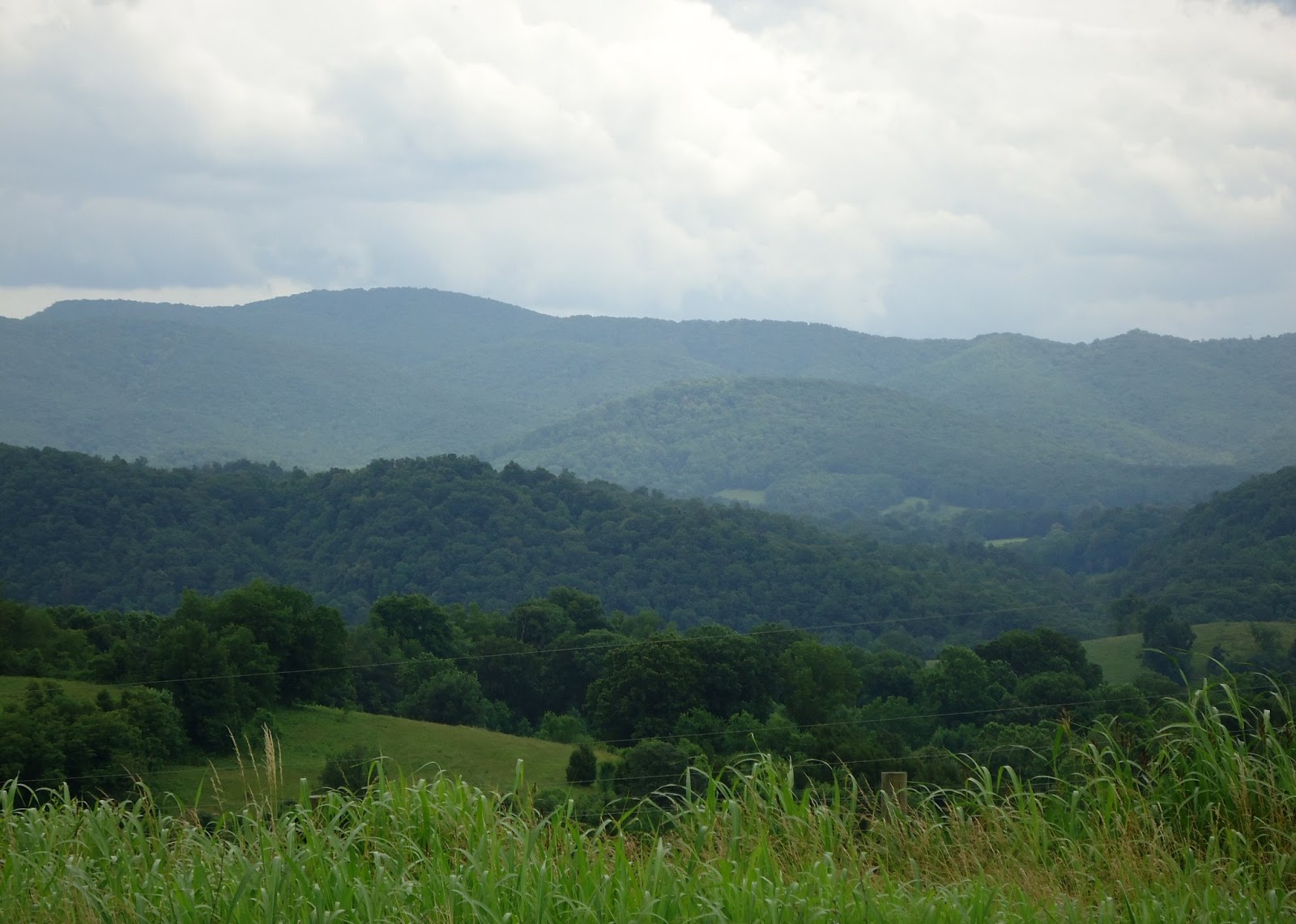
The mountains of southwestern Virginia offer breathtaking vistas as well as great hiking, cycling, horseback riding and camping. We'll try to explore as much of the region as we can during our days off.


Rhododendron blossoms dot the forest.